
What Is Onchain Trade Finance? The Future of Global Trade
Global trade has always run on trust, financing, and a mountain of paperwork. Even with modern digital banking, moving goods across borders still relies on manual verification, separate systems, and a web of intermediaries. For small and medium-sized enterprises (SMEs) trying to secure working capital, these delays and costs can cause costly roadblocks. Enter onchain trade finance.
By using blockchain technology to digitize, record, and automate transactions, blockchain can bring international trade into the modern era. Instead of siloed paperwork, the blockchain is a shared digital infrastructure for trade data, financing assets, and contracts.
Here is a look at what onchain trade finance is, how it works, and why it is catching the attention of global financial institutions.
What is it, really?
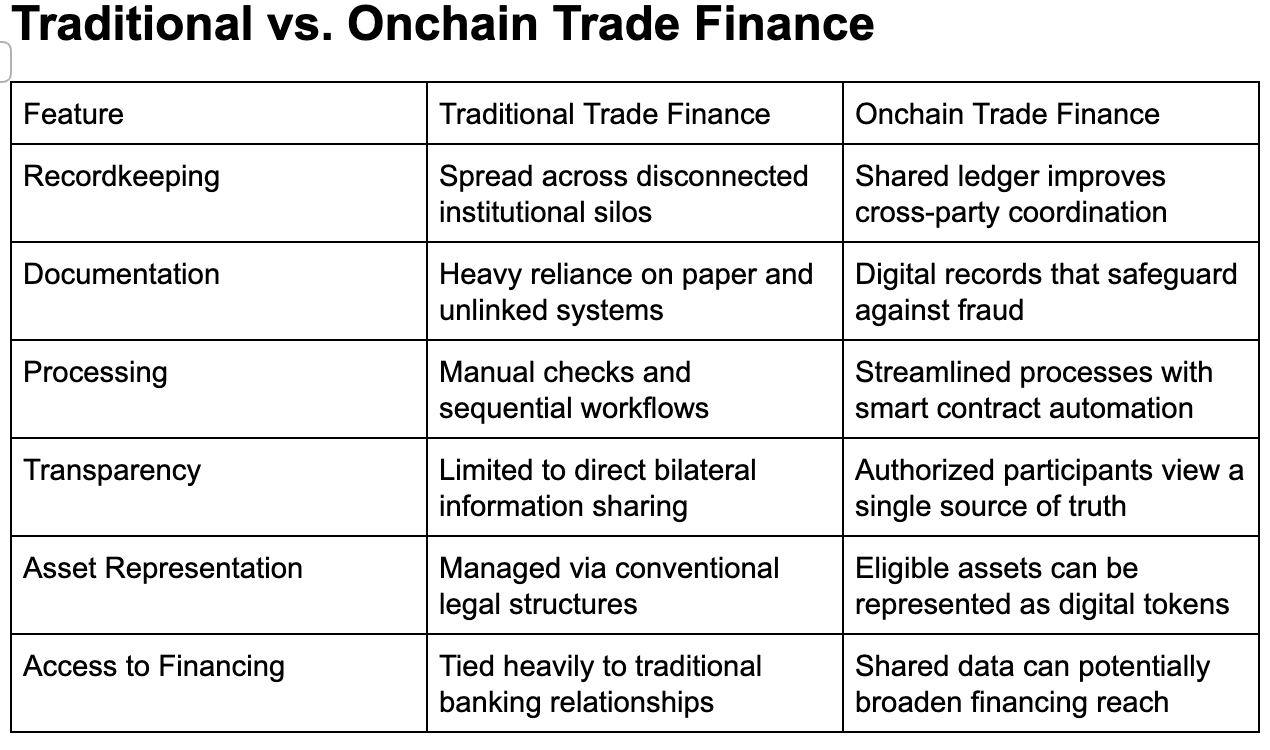
Traditional trade finance relies on industry-standard instruments like letters of credit, bills of lading, bank guarantees, and invoice financing to keep goods moving between buyers and sellers.
Onchain trade finance takes these same processes and instruments and moves them onto a blockchain – a distributed digital ledger that is secure, verifiable, and tamper-resistant.
Rather than just emailing PDFs back and forth, participants can use a shared database where authorized parties can verify information and execute actions using smart contracts (self-executing code). For example, an exporter can create a digital invoice, introduce it to a digital lending pool and get financing for that invoice from onchain investors. Once the importer, or buyer, pays the invoice, the system finalizes the settlement and updates automatically for all parties.
Why the Excitement? Key Benefits
- Real-Time Transparency: Everyone, from banks and insurers to customs and logistics providers, operates from the same playbook, drastically cutting down on discrepancies.
- Lower Costs and Faster Processing: Getting rid of repetitive manual data entry speeds things up and slashes operational overhead. Since blockchain rails operate 24/7, payments can be made faster and more efficiently.
- Better Working Capital Access: By making transaction data easier to verify, lenders can assess risk and the cost of capital more efficiently, helping cash-strapped businesses unlock liquidity.
- Asset Tokenization: Businesses can turn verified receivables (like an invoice due in 90 days) into digital tokens, opening up new avenues for institutional investment and transferability. Learn why tokenized invoicing is revolutionary.
- Programmable Workflows: Payments can be tied directly to verified milestones, keeping commercial and financial operations tightly aligned.
How is using the blockchain different from using cryptocurrency?
While both use blockchain tech, their goals are entirely different.
Cryptocurrency is a digital currency operating on a network that trades, sometimes with volatility, on an exchange. Onchain trade finance uses blockchain infrastructure simply to manage real-world commercial transactions. Platforms can rely on traditional bank payments, regulated digital money, or tokenized deposits without forcing businesses to hold volatile crypto.
The Bottom Line
Onchain trade finance isn't just about throwing old processes onto a trendy new tech stack. When done right, it solves real friction points in global commerce, making supply chains more transparent, financing more accessible, and settlements faster.
As legal frameworks catch up and technology matures, it's poised to become a core pillar of how the world does business.
Platforms like Bulla Network bring this exact shift to life by providing the credit and accounting infrastructure needed to turn onchain trade finance into a practical reality. Through onchain invoicing, tokenized receivables, and stablecoin-backed liquidity pools, Bulla connects traditional supply chain operations with decentralized finance, allowing businesses to mint invoices, automate payments, and unlock working capital in a matter of minutes instead of weeks. Write to contact@bulla.network if you would like more information.
See how this works in practice with onchain freight settlement with TCS Blockchain.
Frequently Asked Questions
1. What is onchain trade finance?
It's a system that brings international trade financing onto a blockchain network. Instead of relying on isolated paperwork, manual checks, and endless emails, it uses a shared digital infrastructure to record transactions, verify data, and automate steps using smart contracts.
2. Is onchain trade finance the same thing as cryptocurrency?
No. While both use blockchain technology, their purposes are completely different. Onchain trade finance focuses on real-world commercial transactions, like financing invoices and tracking shipments. Platforms can use traditional bank payments, regulated digital money, or tokenized deposits without requiring businesses to hold volatile crypto.
3. How does it help small and medium-sized enterprises (SMEs)?
Many smaller businesses struggle with cash flow because traditional lenders require extensive paperwork and long-standing banking relationships. SMEs can get financing more easily onchain than through banks, which will often refuse to fund small enterprises. By also making transaction data easier to share and verify securely, onchain trade finance can help lenders assess risk faster and expand access to working capital.
4. Can smart contracts completely automate a trade transaction?
Not entirely. While smart contracts can automatically release payments or update records when conditions are met, they cannot independently verify physical reality, such as whether goods arrived safely or if an invoice was fraudulent to begin with. They still rely on trusted external data and human verification.
5. What is asset tokenization in this context?
Tokenization means turning rights or assets, like a verified invoice due in 90 days, into a digital token on a blockchain. This makes those financial assets easier to track, transfer, and administer, opening up new opportunities for institutional investment.
Related Reading
- Cross-Border Trade Finance: How Blockchain Solves Global Payment Delays
- Blockchain Rails: Transforming B2B Finance
Sources
- World Economic Forum (WEF): Asset Tokenization in Financial Markets: The Next Generation of Financial Infrastructure.
- World Trade Organization (WTO) and Trade Finance Global (TFG): Blockchain & DLT in Trade: A Reality Check (endorsed by the International Chamber of Commerce).
- Chainlink Developer & Enterprise Resources: Blockchain in Trade Finance: An Overview.
- International Journal of Engineering Research & Technology (IJERT): Evaluating the Use of Blockchain in Improving Global Trade Finance: A Research Paper on Blockchain Technology Applications in International Commerce.
- Deutsche Bank Flow, Trade Finance Insights: Trade Finance and the Blockchain: Three Essential Case Studies (examining real-world enterprise pilots like Ornua and Marubeni).