
The Bulla Difference: How We Finance Invoices Onchain

In this article
3. How do we finance an invoice?
4. What makes Bulla different?
5. Where have we financed invoices?
1. What is Bulla Network?
Bulla Network is a protocol for creating decentralized liquidity pools and enabling onchain invoice tokenization. A business turns an invoice into a token, a pool finances it, and the record of that invoice stays onchain from approval to remittance.
Three kinds of participants use Bulla.
- Originators source and manage invoices in a pool.
- Institutions can own and customize a pool to finance the originators they back.
- Liquidity providers supply capital to pools that finance short-term business invoices. Learn more on our protocol page.
2. What problem do we solve?
Suppliers wait for their money, and waiting is expensive.
Picture a trucker who delivers a load and sends the invoice to a retailer. Then the waiting starts. Invoices often take 30 to 90 days to be paid, and some retailers take up to 180 days. These lags have become industry standard. For example, in 2017, Procter & Gamble stretched its payment terms from 75 days to 120.
Most truckers cannot wait that long. The rig still needs fuel, the truck still needs maintenance, and the driver still needs to be paid. The American Transportation Research Institute calculated that the average cost for just maintenance and repair of a truck rose to 21.5 cents per mile from 19.8 cents per mile. For a long-haul truck running about 100,000 miles a year, this works out to be around $21,500 in repair and maintenance alone.
To bridge the gap until they are paid, most trucking companies rely on invoice factoring platforms, but these third-party finance companies utilize slow traditional banking rails and incur many extra costs. The rates are high, the fees add up, and the contracts can be onerous. Typical factoring fees, with all the costs included, can be as much as 3% to 5% APR
We built Bulla to solve this problem. With Bulla, an onboarded business can get paid for an approved invoice almost immediately without waiting on its creditor. Using a blockchain means that invoices can be financed on the same day, 24/7, and the transaction, by being onchain, is transparent and immutable
3. How do we finance an invoice?
Let’s stay with the trucking company. The load is delivered, the invoice is sent, and now the money is stuck. With Bulla an invoice can be minted as an onchain claim and submitted to a pool. Think of it as turning the invoice into a digital token that carries its own terms, backed by a smart contract. Same invoice, new form.
The pool finances it at the terms agreed upon up front. The trucker gets paid without waiting weeks or months on the retailer. Throughout the process, the terms, status and remittance of that invoice are recorded onchain. If anyone involved wants to know where it stands, they can check. Nobody has to chase an email.
4. What makes Bulla different?
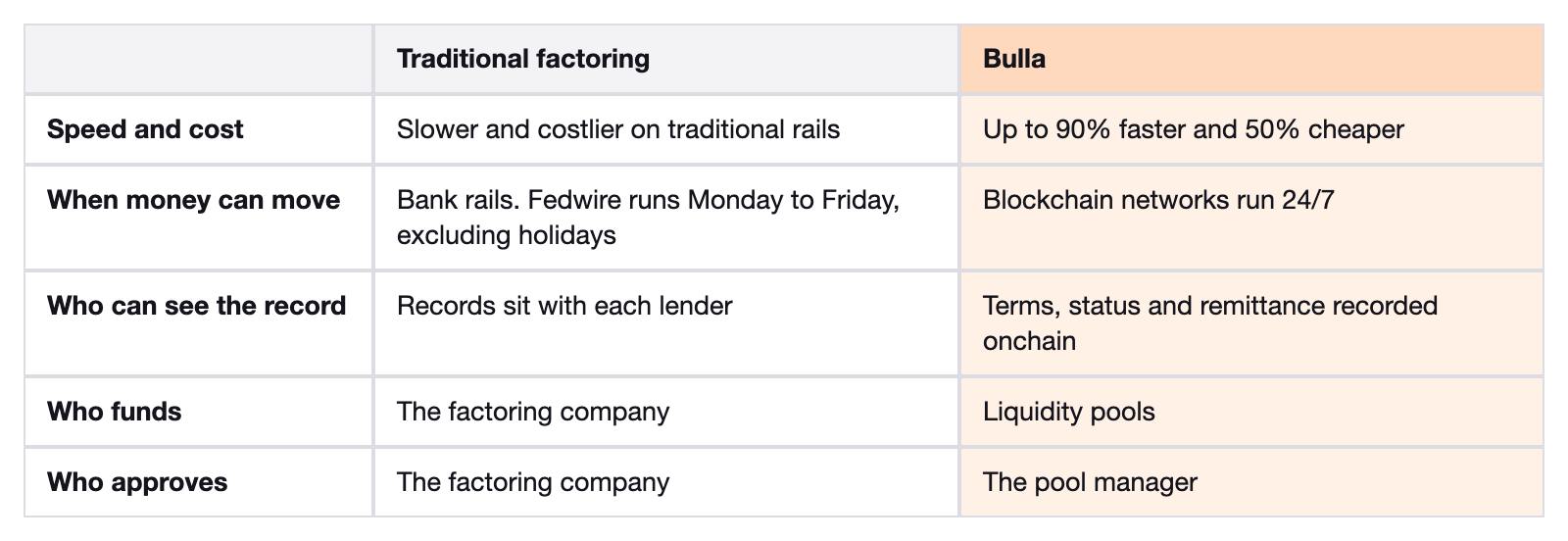
It runs on a blockchain, so it is not tied to banking hours
Blockchain payments settle directly between parties on a shared ledger that runs around the clock, so they skip the intermediary banks, clearinghouses, and business-hours batch processing that can hold up traditional transfers, especially international ones, for days.
It keeps one record of each invoice
The terms, status and remittance of each invoice are all recorded onchain and visible on the Bulla Dashboard, so they can be monitored and downloaded for reporting purposes.
It uses pools that institutions can own and customize
An institution can own a pool and customize it to finance the originators it backs. Liquidity providers supply capital to pools that finance short-term business invoices.
It is funded with stablecoin liquidity
Our pools are funded with stablecoin liquidity. The current pool uses PYUSD on Arbitrum for freight finance, but Bulla can deploy a pool in any stabletoken.
5. How long have we been financing invoices?
The TCS Settlement Pool has been financing freight invoices since August 2024.
6. Who is Bulla for?
- Originators with invoices to finance, reach out to: contact@bulla.network to discuss setting up financing.
- Institutions and liquidity providers, reach out to: contact@bulla.network to discuss owning or funding a pool.
Frequently asked questions
What is Bulla Network?
A protocol for creating decentralized liquidity pools and enabling onchain invoice tokenization.
How is Bulla different from invoice factoring?
Bulla applies the same idea, getting paid before your customer pays you, using tokenized invoices and liquidity pools instead of a factoring company. Each invoice is recorded onchain.
Who approves the invoices in a Bulla pool?
A pool manager authenticates and approves the tokenized invoices the pool finances.
Can an institution own a pool?
Yes. Institutions can own and customize a liquidity pool to finance the originators they back.
Further reading
Invoice Factoring Explained (Plus a 90% Faster Alternative)
How Bulla Network is Pioneering Onchain Invoice Financing
Bulla and partner TCS Blockchain go live with onchain freight settlement
Sources
DAT, Essential Guide to Invoice Factoring for Truckers
Transport Topics, Some Shippers Implement Longer Payment Policies, 2017
Federal Reserve Board, press release, October 9, 2025