
What Is Onchain Private Credit, and Where Does Invoice Financing Fit?

Onchain private credit refers to the practice of extending loans to real-world borrowers with all records and settlements handled directly on a blockchain. Unlike traditional decentralized finance lending models, borrowers are not required to post cryptocurrency exceeding the value of the loan; instead, lenders evaluate the borrower's fundamental creditworthiness or rely on underlying real-world assets, such as commercial invoices, to secure the financing.
This fundamental distinction reshapes virtually every aspect of the lending lifecycle, influencing who can access capital, how risk is underwritten, and the mechanisms that unfold when a loan defaults. This guide explores the overarching concept of onchain private credit, compares it with overcollateralised lending protocols, demonstrates how trade receivables function as collateral, examines the associated risks, and outlines Bulla's role within the ecosystem.
What is onchain private credit?
Private credit broadly encompasses bilateral lending arrangements conducted outside public bond markets, where capital is extended directly to businesses under custom negotiated terms. Onchain private credit adopts this same structure while shifting loan agreements, capital disbursement, and ongoing repayments onto smart contracts that settle primarily in stablecoins.
Industry experts have mapped this workflow across four sequential stages: a borrower proposes specific financing terms, off-chain credit assessments are performed, and approved parameters are programmed into a smart contract that mints a representative debt token. Liquidity providers subsequently deposit stablecoins into the pool to fund the loan upon completion, after which automated smart contracts process borrower repayments, calculate accrued interest, and distribute yields back to lenders.
Although the market remains modest relative to traditional finance, data from rwa.xyz reported on 6 September 2025 recorded $15.95 billion in active onchain private credit loans, with Figure accounting for $11.64 billion of the total, Maple holding $1.23 billion, and Goldfinch managing $64 million. By comparison, Galaxy estimates the broader traditional private credit market at approximately $1.6 trillion.
How does it differ from overcollateralized DeFi lending?
The most widely recognised form of DeFi lending relies heavily on overcollateralization, where standard money markets usually mandate a 150% crypto-collateral ratio requiring borrowers to lock up assets worth significantly more than their requested loans. If the underlying market value of that collateral drops below prescribed thresholds, automated liquidations occur seamlessly without requiring identity verification, as the deposited assets fully buffer lender risk.
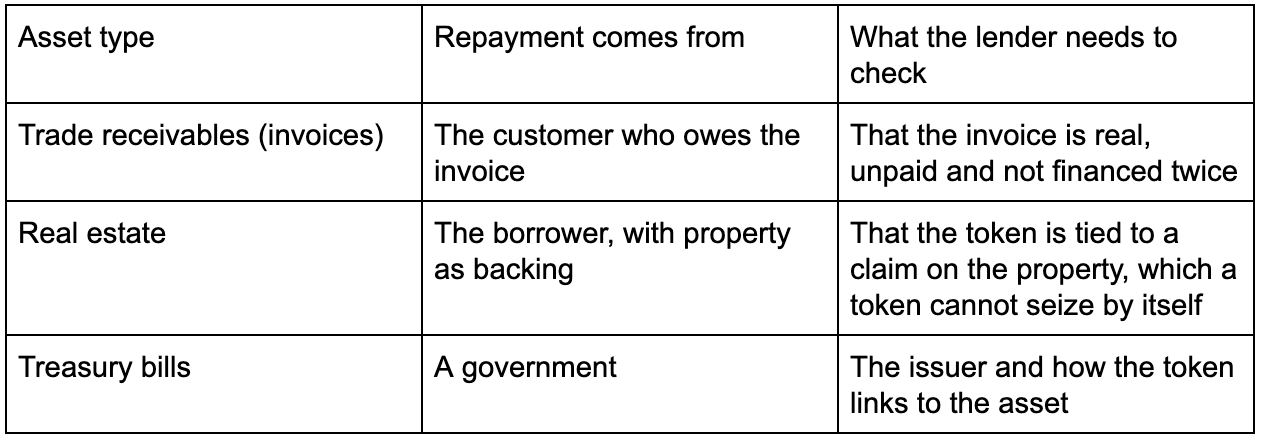
Conversely, private credit operates on an entirely different premise: identity is verified, creditworthiness is rigorously underwritten, and obligations are secured by off-chain assets such as invoices, real estate, or Treasury bills within permissioned pools requiring standard KYC and AML compliance. As Galaxy observes, heavy overcollateralization constraints limit capital efficiency for commercial borrowers, driving market participants toward these alternative structure models.
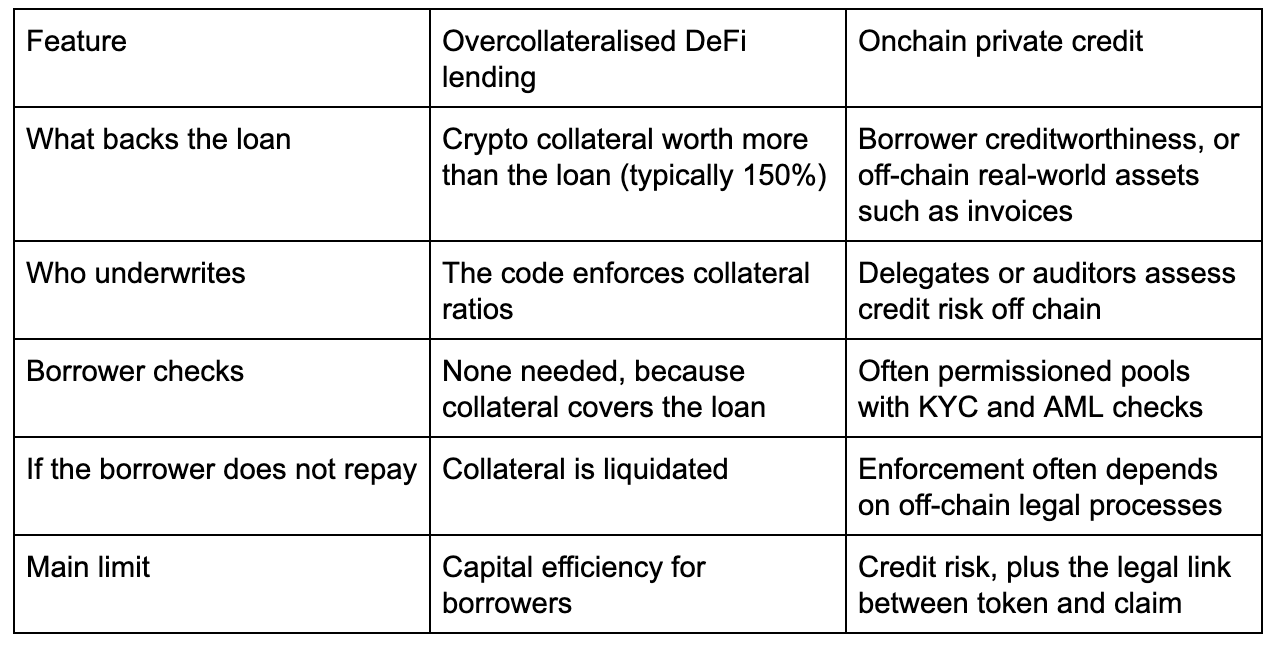
Neither model is inherently superior, as each addresses distinct market demands: overcollateralized protocols offer streamlined, fully transparent execution for leverage, whereas private credit serves businesses seeking operational working capital while requiring lenders to perform comprehensive credit analysis.
Where do trade receivables fit?
Trade receivables represent outstanding invoices for goods delivered or services rendered, effectively serving as short-term claims on capital that a business has earned but not yet collected under agreed payment terms.
Because the repayment source rests clearly on verified commercial customers under explicitly defined terms and maturity dates, receivables represent a natural asset class for onchain private credit, addressing a market backed by substantial global demand reflected in the Asian Development Bank's estimated $2.5 trillion trade finance gap in 2022.
As detailed by Chainlink, financing receivables onchain involves isolating the underlying invoice within a special purpose vehicle, minting a tokenized debt instrument containing the agreement terms, selling that token to investors, and routing incoming customer payments automatically through smart contracts to token holders, a model exemplified by protocols such as Centrifuge.
Chainlink emphasizes that onchain settlement offers substantial speed advantages over legacy banking frameworks by enabling near-instantaneous execution compared to traditional T+2 or T+3 cycles, while simultaneously offering capital providers transparent, verifiable records of ongoing repayments and interest accruals directly on the ledger.
Where does Bulla sit?
Bulla Network operates as a credit protocol designed to provide the modular infrastructure required for liquidity providers to construct, launch, and manage customized pools that finance real-world trade receivables.
Positioned within the trade receivables category, Bulla allows liquidity providers to establish specific pool parameters and legal frameworks while originators source invoices, recording all financing events and remittance streams onchain so that pool health and individual asset performance remain fully transparent to external observers.
Our inaugural live offering, the TCS Settlement Pool, has actively financed freight invoices for the trucking sector since August 2024, deploying more than $7 million in capital to date as we continue expanding custom pool architecture into additional supply chain verticals with unique risk profiles.
Detailed pool analytics and historical performance metrics are available for review directly on the Banker pools page, while comprehensive structural details can be found in our overview explaining how Bulla finances invoices onchain.
Frequently asked questions
Is onchain private credit the same as DeFi lending?
No, standard DeFi money markets rely on crypto overcollateralization, whereas onchain private credit provides uncollateralized or under-collateralized capital backed by real-world assets, creditworthiness, or trade receivables.
What does onchain private credit use as collateral?
Rather than locking up native crypto tokens, these loans are secured by off-chain claims such as commercial invoices, real estate holdings, Treasury bills, or demonstrated corporate credit strength.
Is invoice financing a type of private credit?
Yes, trade receivable financing constitutes a primary branch of private credit, extending liquidity against verified customer debts as highlighted across major industry frameworks.
Who can provide liquidity?
Participation requirements vary by pool, although most private lending structures enforce standard identity verification through mandatory KYC and AML procedures.
Can I see what a pool has financed?
Yes, Bulla maintains complete transparency by displaying active pool data and financed invoice records publicly on the Banker pools page.
Want to see how a pool works?
Protocol and treasury teams interested in exploring the setup and operation of custom receivables pools are encouraged to contact our team or inspect live market data on the Banker pools page.
Sources
- Galaxy, "The New Age in Onchain Credit Markets", 23 February 2026. galaxy.com/insights/perspectives/the-new-age-in-onchain-credit-markets (the $1.6 trillion figure is stated without a date; the Goldfinch 70% figure is stated without a date)
- Chainlink, "Onchain Private Lending", last updated 11 February 2026. chain.link/article/onchain-private-lending
- Chainlink, "Tokenized Receivables", last updated 27 February 2026. chain.link/article/tokenized-receivables-blockchain-liquidity
- Luo et al., "SoK of RWA Tokenization: A Systematization of Concepts, Architectures, and Legal Interoperability", arXiv:2604.06608v2, 14 April 2026. arxiv.org/abs/2604.06608
- Bitcoin.com News, "Active tokenized private credit loans near $16 billion", 6 September 2025, citing rwa.xyz data. news.bitcoin.com/active-tokenized-private-credit-loans-near-16-billion-apr-slips-below-10
- Asian Development Bank, "2023 Trade Finance Gaps, Growth, and Jobs Survey", September 2023 (gap of about $2.5 trillion in 2022). adb.org/publications/2023-trade-finance-gaps-growth-jobs-survey
- Bulla Network, homepage ("$6M+ financed"; TCS Settlement Pool "has financed freight invoices since August 2024"; description of the Bulla credit protocol). bulla.network (the $6M+ figure is shown without a date and grows over time; checked 4 November 2026)
- Bulla Network, Banker pools page. banker.bulla.network/#/factoring/pools