
Invoice Factoring Explained: What Changes When It Moves Onchain

Invoice factoring lets a business sell an unpaid invoice to a factoring company and receive an advance now, instead of waiting for its customer to pay. Bulla Network applies the same idea on the blockchain: tokenized invoices are financed through stablecoin liquidity pools, and the record is kept onchain.
Here is a hypothetical. A trucking company delivers a load on Monday and sends the invoice the same day. The customer is good for the money, but payment is not due yet. Meanwhile the drivers still need to be paid, and the trucks still need fuel.
The business is holding an asset it cannot spend. So what can it do with an invoice it cannot yet cash? Most companies utilize some form of invoice factoring.
What is invoice factoring?
Invoice factoring, also known as accounts receivable financing, involves a business selling its accounts receivable to a third party at a discounted price in exchange for an advance. This arrangement is particularly useful for businesses that struggle with cash flow, as it provides an injection of capital that can be used to cover expenses, invest in growth, or take advantage of opportunities that would otherwise be out of reach.
How does invoice factoring work?
- The business delivers goods or services and sends its customer an invoice.
- It sells the invoice to a factoring company, which checks that the customer is creditworthy.
- The factoring company advances part of the invoice value.
- The customer pays the factoring company.
- The factoring company keeps its fee and passes on the balance.
What changes when invoice financing moves onto the blockchain?
While traditional factoring remains a common option, newer onchain approaches to invoice financing are emerging as an alternative. Onchain financing applies the same core idea as factoring (get paid before your customer pays you) but restructures how it's executed, using tokenized invoices and liquidity pools instead of a private factoring arrangement.
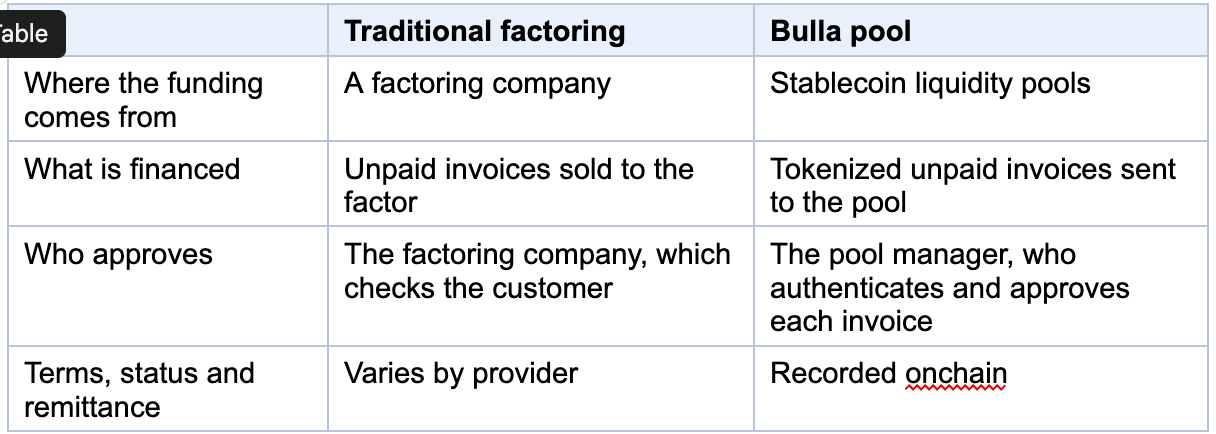
Most people compare financing options by price. A more useful question is where the record of each invoice lives, and who can fund it. Bulla's answer is a pool of stablecoin liquidity, with the record kept onchain.
How does a Bulla pool work?
Bulla describes its protocol as creating decentralized liquidity pools and enabling onchain invoice tokenization.
- Originators source and manage invoices in the pool.
- Pools finance tokenized invoices that the pool manager authenticates and approves.
- The terms, status and remittance of each invoice are recorded onchain.
Institutions can also own and customize a pool to finance the originators they back, and liquidity providers can supply capital to pools that finance short-term business invoices.
To learn more about how onchain invoice financing works, visit Bulla Network's protocol page.
Where is it running today?
Bulla has been financing freight invoices since August 2024. In April 2026, Bulla also received a grant award from Arbitrum DAO's Orbit-track Crypto Cities initiative to deploy a dedicated PYUSD stablecoin liquidity pool on Arbitrum for freight finance. You can read the details in the grant announcement.
Who is it for?
Originators with invoices to finance and institutions that want to own a pool for the originators they back, and liquidity providers. If interested, please reach out: contact@bulla.network.
Frequently asked questions
What is invoice factoring?
It is the sale of an unpaid invoice to a factoring company in exchange for an advance.
What is blockchain invoice factoring?
It applies the idea of invoice factoring on a blockchain, where invoices are tokenized and funded from liquidity pools.
What is onchain invoice financing?
It applies the same idea as factoring, using tokenized invoices and liquidity pools, with the terms, status and remittance of each invoice recorded onchain, as Bulla describes it.
Who approves the invoices in a Bulla pool?
Tokenized invoices are authenticated and approved by the pool manager.
Can an institution own a pool?
Yes. Institutions can own and customize a liquidity pool to finance the originators they back.
Related reading
Who Benefits Most From Invoice Factoring? (Plus a Faster Option)
How Bulla Network is Pioneering Onchain Invoice Financing
Bulla and partner TCS Blockchain go live with onchain freight settlement